

Quick answer: The person running the project or product that creates the risk should complete the DPIA, because they know how the processing actually works. The DPO advises, but doesn't own it. A senior person with real authority over the project signs off and accepts any residual risk, and if that risk is still high, the ICO needs to hear about it before you go ahead.
Contents
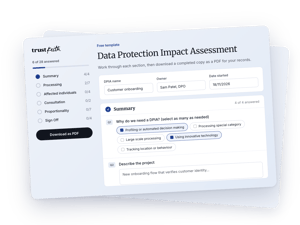
Free Download | DPIA Template
Know who does what, then get it written down.
A DPIA is much easier when the owner, the DPO and the sign-off all know their part. Our free DPIA template walks you through every step in order, with room to record the DPO's advice and the sign-off, so you're never starting from a blank page.
Download the free templateWho Actually Owns the DPIA?
Here's a familiar scene. A new feature is about to ship, someone says "we'll need a DPIA for that", and every head in the room turns towards the same person. The DPO. Or whoever's closest to the DPO. Or whoever looks least busy...
It's the wrong instinct. The DPIA belongs to the person who owns the thing being assessed.
UK GDPR puts the duty on the controller, which means your organisation. Article 35 says the controller must carry out the assessment before the processing starts. In practice, that lands with the product lead, the head of the team, or whoever's accountable for the project. They know what data is going in, where it's going, who sees it and why. Nobody else can answer those questions as well.
That matters because a DPIA written by someone who doesn't understand the processing is a guess with a header on it. It'll look tidy and say nothing.
What the owner is actually responsible for
- Describing the processing, in plain terms: what data, whose data, how it flows, how long you keep it.
- Explaining why it's necessary, and whether there's a less intrusive way to get the same result.
- Spotting the risks to individuals, not the risks to your business. It's a different lens, and an easy one to get backwards.
- Proposing the mitigations, and making sure they actually get built.
Doing the work isn't the same as doing it alone, though. The owner pulls in engineering, security, legal and the DPO as needed. Think of it as the owner holding the pen, with plenty of people allowed to hand over notes.
If you're starting from scratch, the Trust Keith DPIA template gives the owner a structure to work through, so the first draft isn't a blank page.
The DPO's Role: Advice, Not Ownership
So where does the DPO fit? Right beside the owner, but a step back.
The DPO's tasks are set out in Article 39, and one of them is to advise on the DPIA and monitor how it's performed. Advise and monitor. Not write, not own, not carry the can.
There's a good reason for that. The DPO has to stay independent. Article 38 is clear that a DPO shouldn't be given tasks that create a conflict of interest. If your DPO writes the DPIA, approves the DPIA and then monitors whether the DPIA was done properly, they're marking their own homework. It's worth saying plainly: that undermines the whole point of having one.
What good DPO input looks like:
- Challenge, asking whether the processing is really necessary and proportionate.
- A second pair of eyes on risks the owner hasn't spotted.
- A view on the mitigations, and whether they're enough to bring the risk down.
- A recorded opinion, so there's a clear trail showing the DPO was asked and what they said.
Why in-house and outsourced DPOs handle this differently
An in-house DPO knows the business deeply and can be pulled into a DPIA conversation at short notice. That's a real strength. The weakness is continuity. Independence is hard to keep when the same person also holds an operational role, and if they go on leave or leave the company, nobody else knows the role well enough to step in. A DPIA stuck waiting for advice is a launch stuck waiting for a person.
An outsourced DPO sits outside the day-to-day operational structure, so independence comes built in. The honest trade-off is that it can cost more than an in-house hire. Trust Keith's outsourced DPO service is continuous, ongoing support, not a one-off project. Customers get an expert matched to their business, who gets to know their processing the way an in-house hire would. That expert is backed by a full team of DPOs, so if they're ever unavailable, someone else can step in immediately. Your DPIAs keep moving.

Who Signs Off Residual Risk?
Once the mitigations are in place, some risk usually remains. That's residual risk, and somebody has to decide whether it's acceptable.
That somebody shouldn't be the person who wrote the DPIA, and it shouldn't be the DPO. It should be a senior person with the authority to say "yes, we'll live with this" on behalf of the organisation. Often that's a director, the head of the function running the project, or whoever owns risk at board level.
Why? Because accepting risk is a business decision. It's the same sort of call as signing off a budget or a security exception. The owner has a stake in the project going ahead. The DPO has a duty to advise honestly. Neither is the right person to say "this is fine."
What a proper sign-off looks like
- The signer has read the DPIA, including the DPO's advice, and not just the summary.
- They're told plainly what the residual risks are, in language that doesn't need a law degree.
- The decision is written down with a name and a date.
- If they go against the DPO's advice, the reasons are recorded too.
In a scale-up without a full privacy team, this is usually where things wobble. Sign-off becomes an email saying "looks good". That won't hold up if a regulator ever asks how the decision was made. A short, consistent sign-off block at the end of every DPIA fixes most of it.
When You Need to Consult the ICO
Most DPIAs end with a sensible, manageable level of risk. Some don't.
If you've assessed the processing and the risk is still high even after your mitigations, you can't just sign it off and carry on. You need to consult the ICO before you start. The ICO's DPIA guidance explains how that prior consultation works and what the regulator expects to see.
A few things to know:
- It's the exception. If you're consulting the ICO on every project, something's off with either the risk assessment or the project design.
- It's a trigger for a rethink first. Can you change the design, cut the data or add a control that brings the risk down? That's usually quicker than waiting for a regulator.
- The senior sign-off person makes the call to proceed to consultation, with the DPO's advice on the table.
The aim isn't to avoid the ICO at all costs. It's to make sure that if you do go there, you arrive with a clear, well-evidenced DPIA, not a half-finished one.
Keeping a DPIA Risk Register That Actually Gets Used
A DPIA that's finished, signed and filed is a good start. A DPIA that's finished, signed, filed and forgotten is where most organisations end up.
A risk register fixes that. It's one place that tracks the risks from every DPIA, who owns each mitigation, and whether it's been done. Nothing fancy. A spreadsheet works if it's kept up to date.
What to capture for each risk:
- The risk, described in terms of harm to individuals.
- Likelihood and severity, scored on a simple matrix so everyone rates things the same way.
- The mitigation and a named person responsible for it.
- The residual risk once the mitigation's in place.
- Status and date, so you can see what's open and what's overdue.
The register is also how the sign-off person sees the bigger picture. One DPIA might look fine on its own. Ten of them, with the same unresolved supplier issue in every one, tell a different story. It's also tied closely to your wider records of processing, so it helps to keep a clean ROPA alongside it.

Review Cycles: When a DPIA Needs Another Look
A DPIA isn't a one-off exam you pass and forget. It describes the processing as it was on the day you wrote it, and processing changes.
Build in a review cycle. For higher-risk processing, that might be every six to twelve months. For lower-risk, once a year or at a natural checkpoint. Either way, the owner of the project is responsible for keeping it current, and the DPO monitors that it's happening.
Trigger a review early if any of these happen:
- You add a new type of data or a new purpose.
- You bring in a new supplier or move data to a new location.
- You start using new technology, including AI features, on the same data.
- There's an incident or near miss linked to the processing.
- The people affected change, for example you start processing children's data or a new customer group's.
The tools your team uses are a common trigger. If you're rolling out something new, it's worth reading our guide to AI tools and GDPR before the DPIA conversation starts, not after.
Frequently Asked Questions
Who should complete a DPIA?
The person accountable for the project or product that involves the processing. They understand the data flows best. Others, including the DPO, contribute advice, but the owner holds the pen.
Can the DPO complete the DPIA?
They shouldn't. The DPO's job is to advise on the DPIA and monitor it. If they write it too, they can't independently assess it, and that creates a conflict of interest.
Who signs off a DPIA?
A senior person with the authority to accept residual risk on the organisation's behalf. That's typically a director or the head of the function responsible for the project. It shouldn't be the DPO or the person who wrote the assessment.
Does a DPIA have to be approved by the DPO?
No. The DPO gives advice, and that advice should be recorded. Approval and risk acceptance sit with the business. If the business disagrees with the DPO, the reasons should be written down.
What happens if the risk is still high after mitigation?
You need to consult the ICO before the processing starts. It's worth trying to redesign the processing first to bring the risk down, as consultation should be the exception.
Free DPIA Template
Knowing who does what is half the battle. The other half is actually writing the thing. Our free DPIA template walks you through every step in order, with room to record the DPO's advice and the sign-off, so nothing gets missed and nothing gets signed by someone who never read it.